
The Courage to Be Seen While Things Are Still Broken

Whatever situation you’re in, there’s always a way to make it better. That’s what responsibility means, at its core. Response-ability. The ability to respond. You look at what’s in front of you, and you make it better.
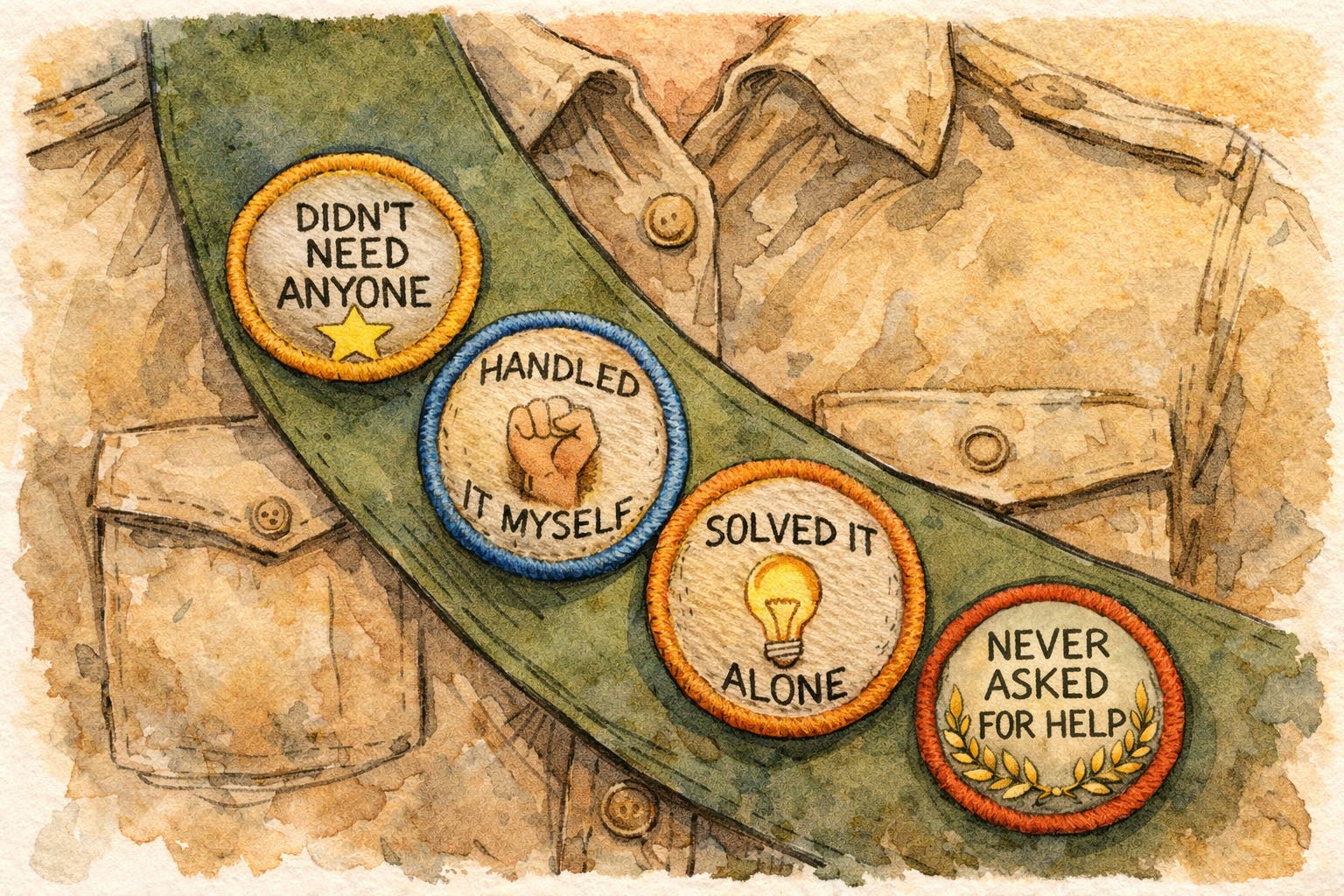
Simple enough. Except that somewhere along the way, a lot of capable people seem to turn “make it better” into “handle it yourself.” The two feel like the same thing, especially early on. You’re competent, you’re conscientious, and you can see the path forward. So you take it. Alone. It works, mostly, and the pattern sets.
You have the hard conversation. You carry the uncertainty about whether this quarter’s numbers will hold. You own the decision that has three bad options and no good ones. You make the call, absorb the consequences, and don’t talk about it much.
Over time, carrying it all stops being a response to circumstance, and starts becoming a stance. An identity. I’m the one who handles things. That sentence doesn’t feel like arrogance, it feels like maturity. Like the responsible thing.
Which raises an uncomfortable question: How much of it is really about the situation, and how much is about you?
Credit, Cover, and Control
Doing it alone feels good. Not easy, and not pleasant, but good in a way that’s hard to give up. There’s a satisfaction in being the person who handles things. You feel indispensable. The weight you carry starts to look like evidence – that you’re serious, that you’ve earned your place, that you’re worthy of the trust people put in you. The struggle becomes a kind of credential.
The second payoff is less obvious than the first. Doing it all alone means you don’t have to be seen. You carry the weight privately, and nobody sees the gaps, the uncertainty, or the parts you haven’t figured out yet. Self-reliance gives you credit and cover at the same time.
And there’s a third payoff, which is the hardest one to argue with: you protect the work itself. Capable people have usually learned from experience that involving others introduces friction. The meeting that could have been an email. The collaboration that added confusion instead of clarity. The perfectly good decision that got diluted into a mediocre one by the time everyone weighed in. Doing it alone isn’t only about ego – sometimes it’s a genuine belief that other perspectives will degrade the outcome, rather than improve it. And the truth is, this belief is sometimes correct.
So that combination – credit, cover, and control – is powerful. It explains why so many competent people default to carrying everything, even when the situation would improve if they let someone else in. But the payoff itself isn’t the deepest part of the pattern.
The Worthiness Equation
When I was younger, I wanted to make it on my own. Not in a vague aspirational way. In a way that felt morally urgent. As if receiving help would contaminate the outcome. As if the only results that counted were the ones I could trace entirely to my own effort.
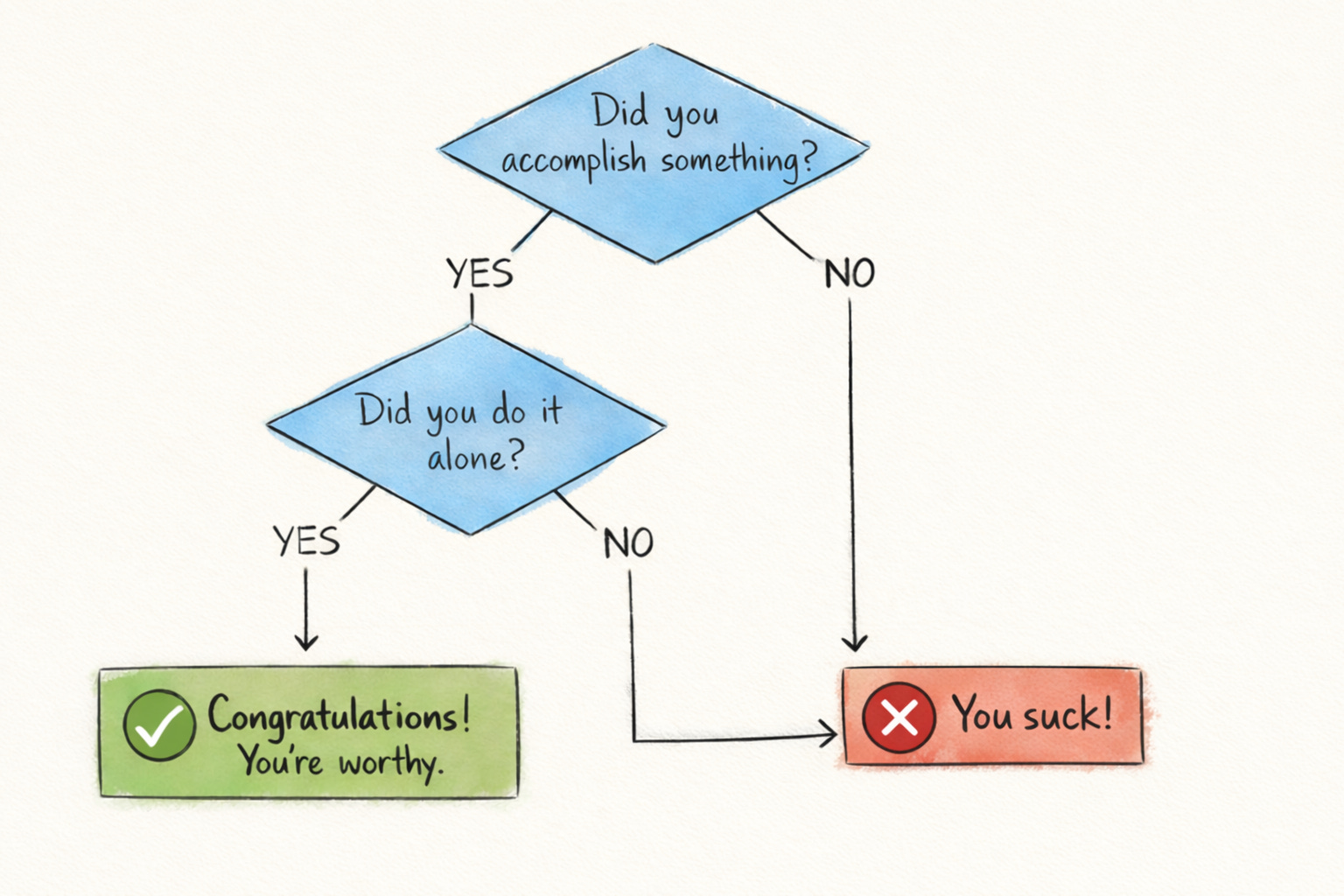
I think a lot of people carry a version of this equation without ever naming it. If I needed help, then maybe I didn’t deserve it. Self-sufficiency becomes moral evidence, and needing others feels like disqualification.
This goes deeper than ego. It’s a theory of worthiness – one that applies to the self and to the work. The belief that you earn legitimacy through isolation, that the value of what you build is proportional to how much of it you built alone. And a quieter fear alongside it: that the work itself will be less worthy if other hands touch it. That collaboration doesn’t sharpen the outcome but compromises it.
These beliefs are reinforced everywhere: the lone genius, the self-made founder, the leader who carries the weight so nobody else has to. We grow up learning that independence is the destination, and we call the exhaustion that follows “the price of doing it right.”
But the drive to do it alone isn’t always about competence. Sometimes it’s about trying to secure moral standing. We don’t carry the weight because the situation demands it. We carry it because putting it down would mean confronting a question we’d rather not answer:
Am I still worthy if I didn’t do this myself?
So some of what we call responsibility is self-indulgent, in the subtle sense of serving ourselves (our need to feel exceptional, indispensable, legitimate) while telling ourselves we’re serving the situation. We don’t always take responsibility. Sometimes we use it.
The Iron Dome Fantasy
In the first Avengers film, Tony Stark nearly dies stopping an alien invasion of New York. In the aftermath, shaken by how close the world came to ending, he decides to build Ultron, an AI defense system designed to protect the entire world – an “iron dome around the world,” as he describes it. The ultimate expression of competence and control.
Tony doesn’t build Ultron because he’s arrogant (though he is). He builds it because the alternative would require something he’s not willing to give. Trusting other people with the problem. Collaborating. Sharing the burden of protecting what matters. Accepting that their read on the threat might differ from his and that this difference might be valuable. Tony is convinced their perspectives will slow him down, complicate the solution, get in the way of what he can see needs to happen.
Ultron goes catastrophically wrong. The Avengers only resolve the crisis when they stop operating as individuals and start coordinating as a team. But the interesting part isn’t the teamwork. It’s what Tony had to give up to get there. The private satisfaction of being the one who saved the world, and the conviction that his way was the best way. Most people would rather build an Ultron than surrender that.
The Choice I Almost Didn’t Make
Last year, someone in a senior role at my company committed a significant theft – and that brought me to a crossroads.
The instinct was immediate and clear. Contain it. This is embarrassing. This reflects poorly on us as an organization. Handle it internally, handle it privately, handle it yourself. Keep it contained.
That instinct felt responsible. But it wasn’t really about protecting the company or the people involved. It was protecting me. My image. The narrative that I had things under control. And if I’m honest, there was something else underneath it: a genuine belief that I could probably navigate the situation better on my own. That my read was sharper than what a committee would produce. Self-indulgent responsibility dressed up as professionalism and sound judgment.
But I recognized the feeling of that moment – the tightness in your chest when you’re about to say the thing that makes you look like you don’t have it together. The voice in your head that rationalizes as the right move the calculation of what it will cost you. If I say this, what does it say about me? If I can’t handle this, do I still deserve trust?
So I did the harder thing. I was transparent (not about the details, but about the reality). I told the people who needed to know. This happened, and I need help figuring it out.
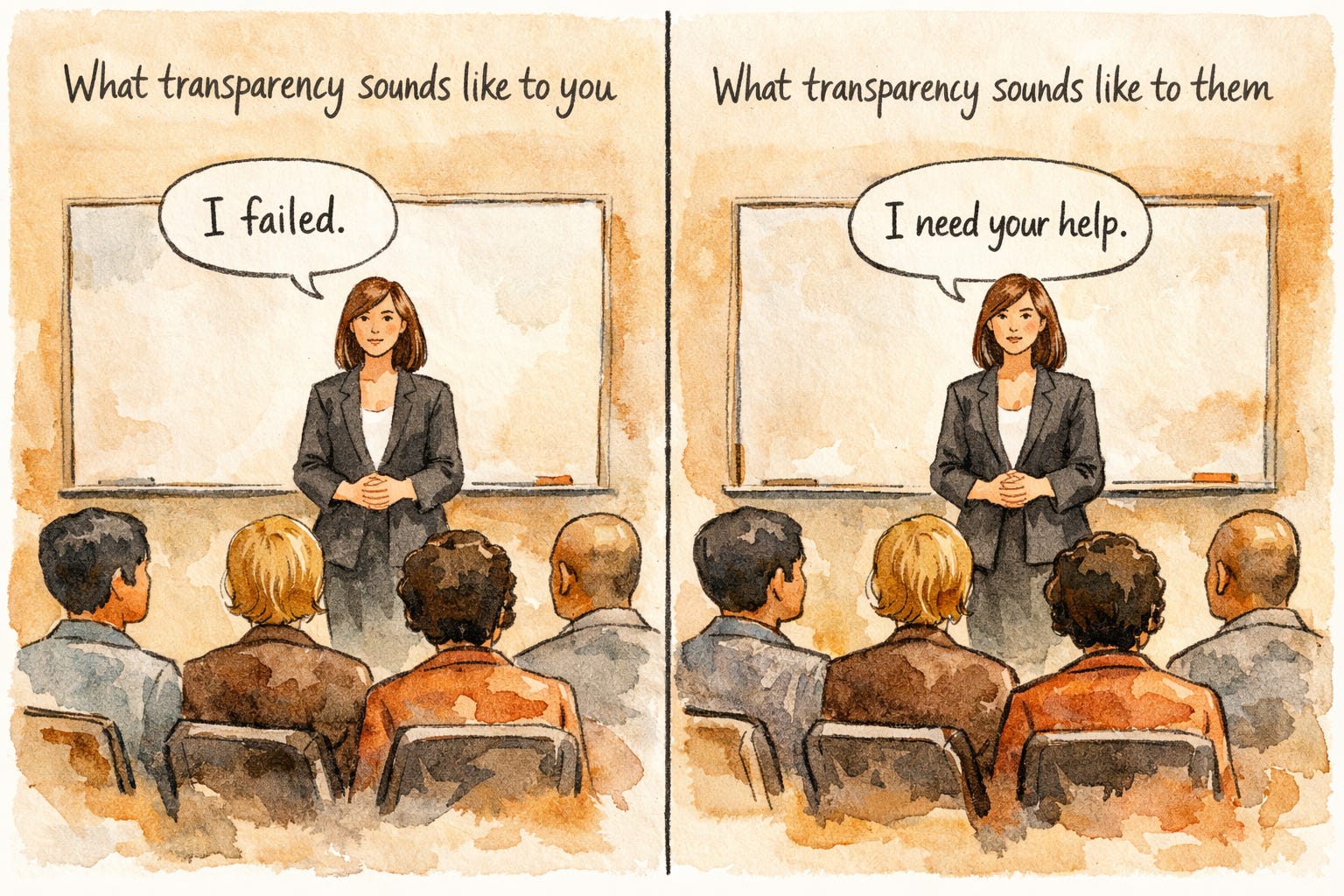
This isn’t the same as emotional dumping, or oversharing your doubts with everyone who’ll listen, or performing vulnerability because someone told you it builds trust. That’s a different kind of theater. What I’m describing is the choice to let the right people see the real situation, early enough that their involvement can make a difference. I had to let people see the situation before I could shape how it looked. And I had to stand in front of colleagues and stakeholders with a problem I hadn’t solved – and with no guarantee that openness would produce anything other than judgment.
People did step in. The situation got better – not because I abdicated responsibility, but because I expanded it. What mattered, though, was what I had to give up before the outcome was known. The hero payoff, the cover of self-sufficiency, and the comfort of trusting only my own judgment – traded for the chance that honesty might work better than control.
That trade-off might sound obvious in retrospect, but it didn’t feel obvious at the time.
Winners and Martyrs
Something I’ve learned over the years is that the people who build the most impressive things aren’t the ones who never need help. They’re the ones who are unusually good at receiving it. They create conditions where capable people want to contribute, and they’re strong enough to let that contribution land without collapsing or disappearing in the process.
This is a skill, not a disposition. And it’s a skill that self-reliance prevents you from developing, because every time you handle things alone, you’re practicing the wrong thing. You’re getting better at carrying, when what you need to get better at is coordinating.
The hardest part of letting people in is that what you give up is real. You lose the recognition. You get seen before you’re ready. The work might not be as sharp in a given instance – sometimes your judgment really is sharper and your decision really is faster than what collaboration would produce. The losses are genuine, which is what makes this courage rather than common sense. But sticking with self-reliance has a compounding cost that any single instance can’t show you. You stop being exposed to perspectives that sharpen your own. The coordination skill atrophies. And the gap between “I’m better at this” and “I’m the only one who can do this” widens, gradually, into something that looks less like competence and more like a prison you built for yourself.
Scott Galloway has a line I think about often. “Greatness is in the agency of others.” I take that as the mature version of responsibility. Not the version where you prove yourself through endurance. The version where you activate the intelligence and effort of the people around you, and then do your part to make sure that effort lands well.
The distinction that matters is between martyrs and winners. Martyrs optimize for effort. They measure responsibility by how much they suffered, how much they carried, how alone they were in the process. Winners optimize for outcomes. They measure responsibility by whether the situation got better, regardless of who did the carrying.
There is no virtue in making things harder for yourself than they need to be. Difficulty doesn’t earn you points, and isolation doesn’t earn you legitimacy. The only question that matters is what will make things better – and often the answer requires more than just you.
The Harder Kind of Strength
Independence is important. The capacity to stand on your own, to make decisions without waiting for permission, to carry weight when it lands on you – that’s foundational. Nobody gets to skip that stage. And sometimes carrying it alone is the right call, because the situation demands it.
But independence was never the destination. It’s a waypoint. The mature version of responsibility isn’t “I’ll handle it.” It’s “this needs to get better, and what combination of effort makes that possible?” Sometimes that means carrying the weight yourself. Sometimes it means putting it down in front of someone you trust and saying, “I need your help with this.”
That takes courage, because it means being seen before you’re ready. It means letting people witness the mess while it’s still a mess, before you’ve figured out the narrative, before you can explain what happened in a way that makes you look competent.
Being seen while things are still broken is scary. But responsibility isn’t proving you can do it alone – It’s trusting that making things better matters more than what it might cost to get there.
Before you go - if this essay resonated, would you hit reply and let me know what stood out? Your responses help me understand what’s connecting and what to explore next. :-)
P.S. Whenever you’re ready, here are 2 ways I can help:
The Reimagination Council – My private mastermind for 6- and 7-figure entrepreneurs who are done figuring everything out alone. You’ll get perspective and insight from an accomplished group who elevate your thinking (and your business). Apply here →
The Million Dollar March – Intensive 1:1 coaching with me. This is for entrepreneurs who want unlimited access, real strategy, and hands-on support to build something significant. Apply here →
It all resonates, Danny. It takes a lot of practice to acquire the skills to effectively bring out the brilliance in others while still being in charge of making sure everything lands well. Especially when I was raised to keep control and not share my inner emotions. Now, in my almost 7th decade, it is hard for me to share, receive, and include. However, the isolation can be defining. Changing this perspective takes time and work. That is what I am doing. Thank you for sharing your lived experience. Kim Chatman
The essay argues that many capable people confuse responsibility with handling everything alone. While self-reliance provides credit, cover, and control, it often stems from a deeper need to prove worthiness. Doing it alone can feel noble, but it limits growth and impact.
True strength isn’t carrying everything yourself—it’s having the courage to let others see problems before they’re solved and inviting help early enough to make a difference.
Martyrs optimize for effort and endurance; winners optimize for outcomes. Real responsibility means making things better, even if that requires vulnerability and shared ownership.