
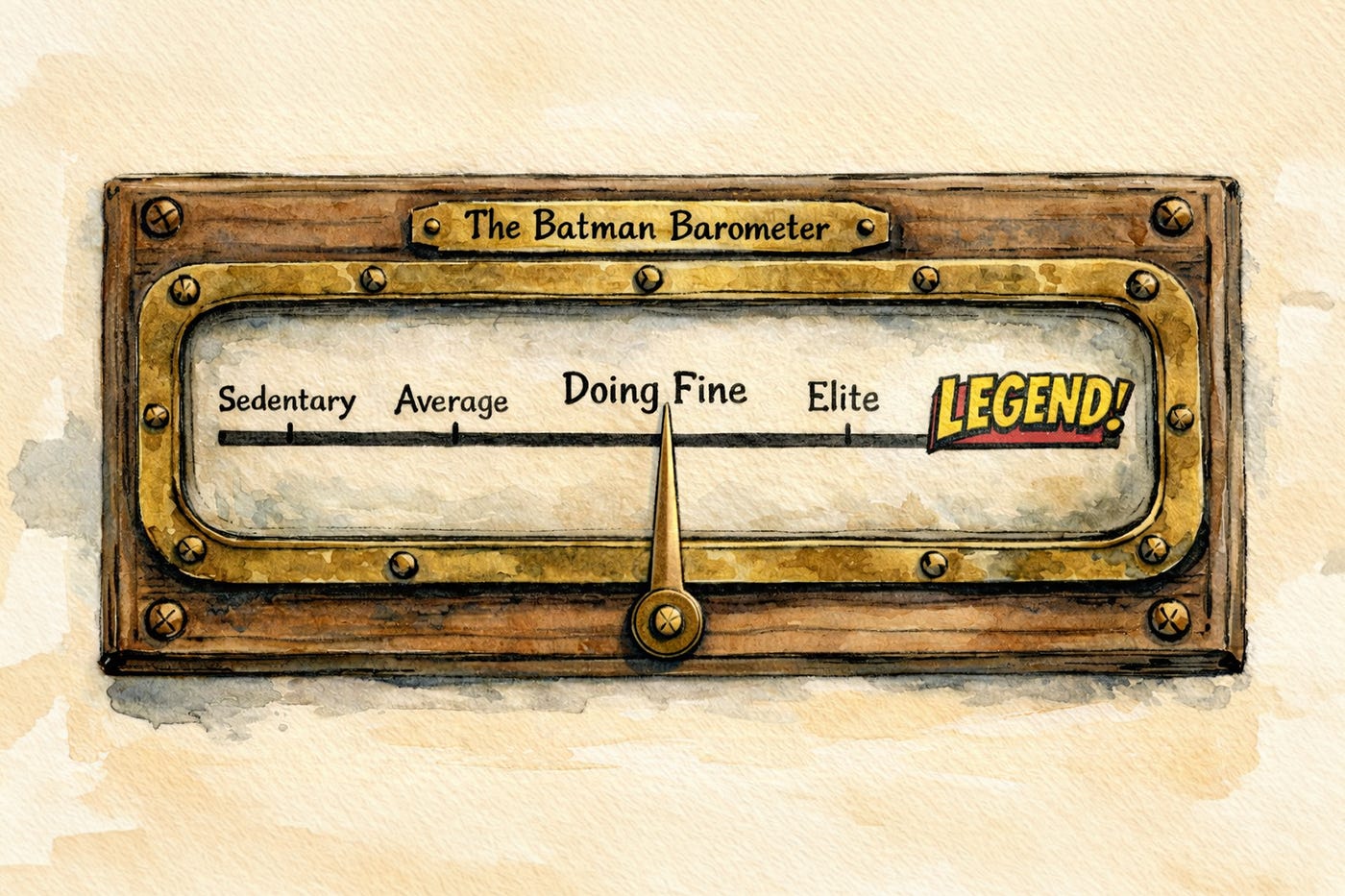
The Batman Barometer

I love the training sequence in Batman Begins. Hidden away in a mountain monastery, Bruce Wayne spars on a frozen lake and runs punishing drills in the most challenging conditions. The lighting is cinematic and the commitment is total – because that’s what it takes to become a man who will eventually fight crime in a cape.
And every time I watch it, I catch myself measuring my own life against what’s on screen.
Now, I’m in better shape than most people my age. I walk for hours every day, and hold myself accountable to monthly fitness tests – so by any reasonable standard, I’m doing fine.
But “fine” never quite lands when Batman is on the screen.
The same feeling showed up years ago when The Social Network came out – not quite inspiration and not quite envy. Zuckerberg was a couple of years younger than me (still is, obviously), and watching the story of Facebook’s rise landed less as inspiration and more as a discouragement. Whatever I had built, whatever progress I felt good about, suddenly seemed minor. It felt like a voice chiding me: “You thought you were doing well? Let’s get real. You’re not even a contender.”
Every domain has these figures. When I was in my twenties, focused on business, they were people like Gates, Jobs, and Bezos. But every era and domain produces the Batman of their respective arenas, people who have gone so far beyond where you are that they reset the frame entirely.
And when the frame resets, two things happen at once.
First, you shrink. Whatever you’ve built feels smaller by comparison. You walk away a little deflated.
But second – and more quietly – you’re released.
A bar that high effectively takes you out of the game. The gap isn’t incremental, it’s categorical. And a categorical gap stops being a driver. It becomes symbolic.
You can admire it. Aspire to it. Even feel bad about it. All without changing your Tuesday. The comparison doesn’t just make you feel small, it also makes the effort feel irrelevant.
The thought never quite forms into words, but it’s there. Why bother training at all? Regardless of how some people might see me, it’s not like I’ll ever actually become Batman!
And that combination is strangely, and dangerously, comfortable. Because sure, there are some people who aim at extreme outcomes and mean it – who genuinely believe the goal is achievable and organize their entire lives around that belief. It’s rare, but it happens. What’s much more common, though, is pointing to an extreme outcome as a symbol of who you’d like to be, without ever quite believing it enough to act on it. The aspiration stays directional rather than operational. And as long as it stays that way, it never forces a tradeoff.
The Imaginary Door #3
I didn’t have language for this when I first watched Batman Begins or The Social Network. It just felt like a loop I cycled through – watch something extraordinary, feel smaller for a while, then drift back to normal life. But over time, I began noticing the same rhythm in conversations with my students about sales and growth.
When I work with students on sales, I tell them their job isn’t to convince. Rather, their job is to get people honest about the choices they’re making.
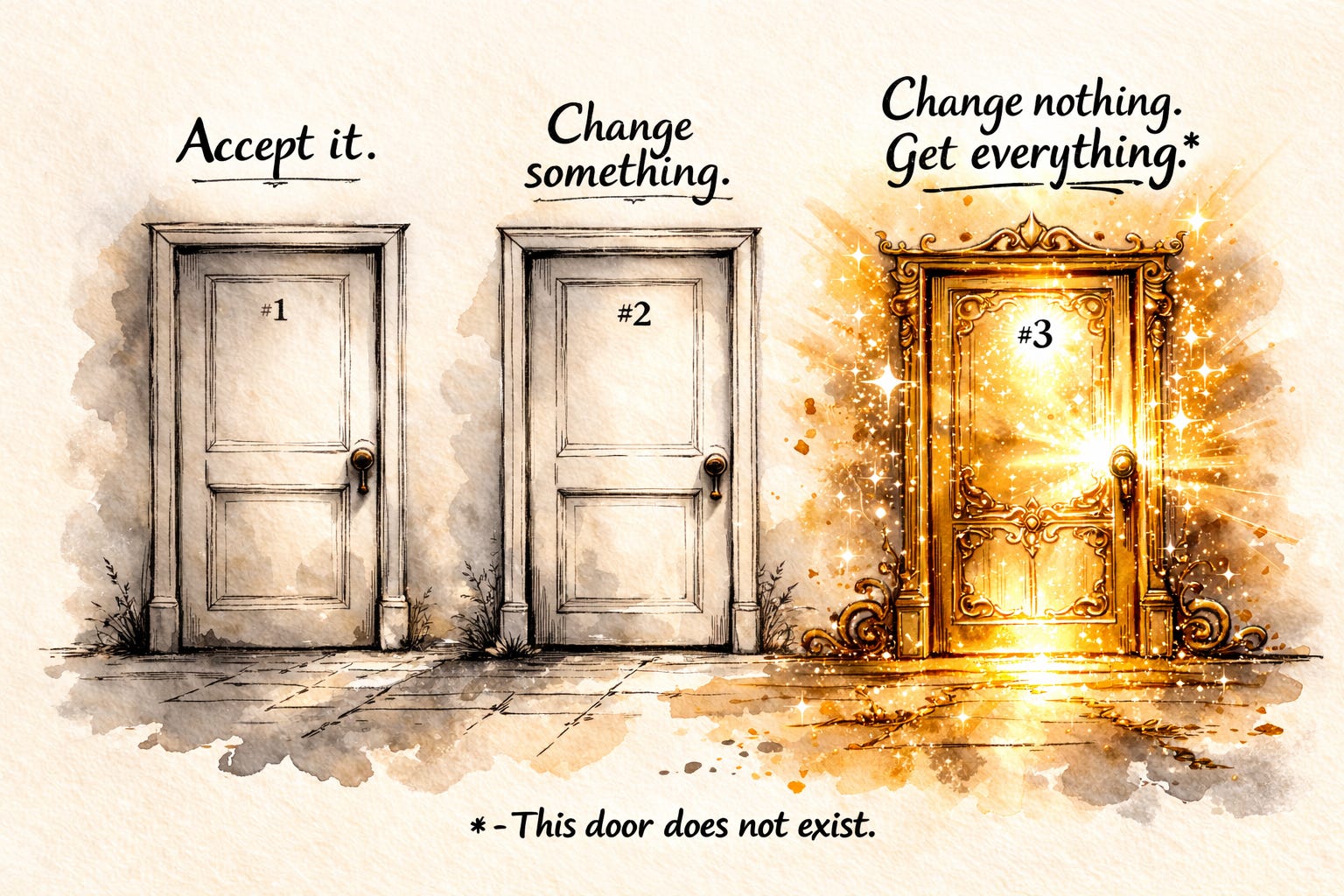
Because there’s always a real choice. You can keep doing what you’re doing and accept the outcomes that your current approach produces. Or you can change something – reconfigure your inputs, accept the cost, see where a new trajectory could lead. Both are legitimate, and which choice is right will depend on the priorities of the person doing the choosing.
The problem is that most people don’t want to choose between these two options. Instead, they wait for a magical “door #3”, where they don’t have to do anything differently – no restructuring, no sacrifice – and yet the outcomes change anyway.
You probably know the pattern. You feel the gap between where you are and where you want to be. But instead of sitting with the tradeoff, you start researching. Browsing for exercise equipment. Comparing marketing systems. Reading about someone else’s shortcut.
The activity feels productive. You’re not ignoring the gap, you’re engaging with it. But the engagement is lateral. It has the texture of movement, without the cost of commitment.
For a few hours, it feels like action. But nothing fundamental shifts. Your week looks the same. Your inputs stay the same. Nothing is sacrificed.
It’s door #3, which is the definition of insanity: change nothing, but expect different outcomes. That’s what most people experience as being stuck. Not from a lack of effort, but a refusal to eliminate imaginary options. And we do it because, as long as the hope of door #3 is alive, you never have to answer the hard question underneath it all… What am I actually willing to change?
When Desire Stays Unpriced
Dorothy Parker famously said she hated writing, but loved “having written.” It’s one of those lines that gets a knowing laugh because the gap it names is so universal. Most people recognize themselves in it immediately.
But it’s more than a clever quip – it actually describes a deep truth of the human condition: the desire for a state without the willingness to endure the process that produces it. She was talking about writing, but the same structure shows up everywhere. You want to have built the business, gotten in shape, written the book, learned the language. The past tense does all the heavy lifting, because it lets you skip the messy, repetitive, unglamorous middle where the actual work happens.
I think this is what most people mean when they say they “want” something ambitious. They mean they like the outcome. They admire it. They can imagine themselves in it. But they don’t want it enough to rearrange their week around it. Do I want to be fit like Batman? Sure, but not enough to actually build a life that would make that outcome possible. The moment the goal stops being flattering and starts issuing demands, something else wins.
Most people who carry these “unpriced aspirations” are hardworking. They have real accomplishments under their belts. The gap isn’t between them and apathy. It’s between how they see themselves (as having serious, meaningful goals) and the specific, repeatable changes those goals would actually require. As long as the aspiration stays abstract enough, the gap never has to be confronted.
And there are always reasons to defer. You have a full week. The timing isn’t ideal. You’ll start fresh on Monday. Taken individually, those reasons are valid. But the pattern they create is that the right moment to commit never quite arrives. The aspiration remains parked just before the point where it would actually cost you anything. You don’t experience it as avoidance, because each delay feels rational on its own.
I’ve been telling my students for years that goals only matter in the context of tradeoffs. As long as you can theoretically have everything, your goals don’t tell you much. Want Batman-level fitness? Sure. Want a million- (or hell, billion-) dollar business? Absolutely. Want to write a bestselling book and be an engaged parent and learn Mandarin and master the violin?
Sure, that all sounds good – but if you try to do it all at once, you won’t achieve any of it. As the saying goes, you can have almost anything you want in life – but not all at the same time.

Goals that never force you to choose against something else are strategically empty. They let you feel serious without requiring you to be specific.
And specificity has a cost. The moment you translate “I want to be in great shape” into a training schedule and a dietary overhaul, the aspiration stops being inspiring and starts being expensive. Translate “I want to grow my business” into a specific number of sales conversations per week, and the romance of entrepreneurship instantly gives way to a Tuesday afternoon of unglamorous outreach.
Most people opt for vagueness right at that inflection point, where aspiration collides with a concrete, repeatable cost. Vagueness is emotionally efficient. It lets you keep the aspiration without paying for it. And as long as you stay vague, you never have to find out whether you’d actually choose differently, because Door #3 still feels available.
What Your Floor Reveals
We’ve established that aiming at an unattainable pinnacle is problematic, but that doesn’t mean you need to shrink your ambitions. The winning move is something else entirely. It’s to define a floor.
Not the best-case outcome. Not the cinematic version. Just the minimum standard you’re willing to hold yourself accountable to, right now. Floors are unglamorous – much more boring than lofty aspirations, and also much more honest.
My fitness tests aren’t impressive or even meaningful by anyone’s standard but mine. They’re not supposed to be. Fifty consecutive push-ups, fifteen consecutive pull-ups, and a handful of other benchmarks, repeated every month. They’re a floor, not a ceiling.
They work because they’re impossible to fake. You simply can’t do it without adhering to what I’ve defined for myself as the minimally acceptable bar. The test doesn’t care about your intentions or the equipment you just ordered. It encodes weeks of repeatable effort, or it exposes weeks where that effort didn’t happen. One-off heroics are irrelevant. The signal is whether the system holds over time, and the feedback is immediate – if I struggle on a test, I know that I need to step up my game.
And that’s what makes baselines different from aspirations. An aspiration can float indefinitely, unpriced, without ever touching your calendar. But a baseline reports back every time you check it. The numbers either show that you’ve done the work, or they show that you haven’t.
The same logic applies beyond fitness. In sales, the meaningful measure isn’t the revenue target – that’s too far downstream, too shaped by forces beyond your control. The real measure is the number of real conversations you have each week. Something close enough to your inputs that it reports honestly on how you’re actually spending your time, not how you wish you were.
The floor you’re willing to be audited against reveals which life you’ve actually chosen.
Still Measuring
I still think Batman Begins is a great movie, and I look forward to sharing it with my kids – when they’re a little older. The Social Network… well, these days that’s more of a cautionary tale. ;-)
But when I watch Batman, it’s for entertainment . I still notice the gap between his physique and strength vs. mine, but the gap reads differently now.
When the dissatisfaction shows up – watching someone operate at a level I admire but haven’t approached – I sit with it long enough to ask: What would the baseline look like? What would I have to rearrange? And is that a life I’d actually choose?
There’s a relief in just asking, even before the answer arrives. It takes some options immediately off the table, which makes the remaining choices easier to make. Stay where you are and own it, or accept the cost of changing your inputs. Both are real. Neither requires pretending.
Usually, the aspiration isn’t strong enough to justify the tradeoff. And that’s fine. But sometimes it is.
The difference now is that I don’t confuse aspiration with commitment.
Aiming high isn’t the problem. Pretending you’re aiming high is.
Once Door #3 is gone, the choice is yours – and so is the life that follows.
Before you go - if this essay resonated, would you hit reply and let me know what stood out? Your responses help me understand what’s connecting and what to explore next. :-)
I relate to this so much Danny! You are right, goals mean nothing if you’re not willing to trade anything for it. And, the concept of defining your floor, your bare minimum is the most practical way to not remain in the aspirational state forever. I always tell myself to do the smallest thing I can today.. write one paragraph, do one push up, read one page.. and then do it consistently to form the habit.
I love this, thanks for sharing!
"Aiming high isn’t the problem. Pretending you’re aiming high is" ....
Monday morning strong cuppa coffee, smack on the head stuff.
Well written and thanks.