
Always Do the Small Hard Thing


Every year, I take each of my kids on a one-on-one trip for their birthday. It’s become one of my favorite traditions – a few days of undivided attention and conversations that wouldn’t happen at home. For Micah’s 9th birthday, he wanted to go to Mexico City. One day, as we were leaving the hotel room (on the third floor), I suggested we take the stairs.
He wanted the elevator. Of course he did. He’s nine, and the elevator is right there – why would anyone choose effort when convenience is available?
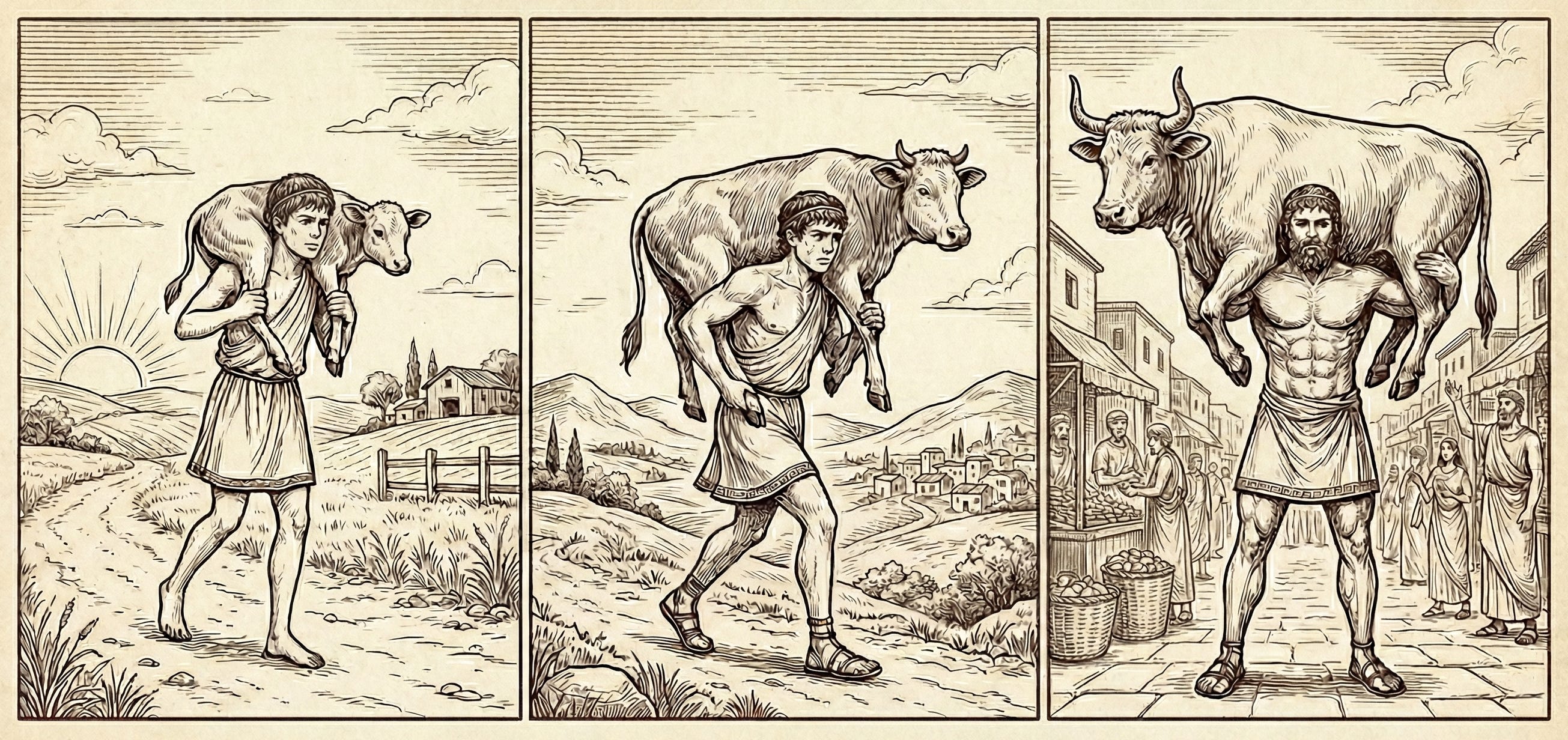
So I told him the story of Milo of Croton.
In Greek mythology, Milo was a wrestler who, as a young man, began carrying a newborn calf on his shoulders every day. He took it to the market and back – nothing dramatic. But he did it consistently, day after day. And he kept doing it even as the calf grew. By the time that calf had become a full-grown ox, Milo had become one of the strongest men in the ancient world.
The growth was so gradual, so incremental, that each day felt almost the same as the one before. He was getting stronger, so he never noticed the weight increasing.
This is the earliest recorded example of progressive overload – the principle that underlies all physical training. But it’s so much more than building muscles.
It’s how capacity gets built. Any capacity.
What Discipline Actually Is
So what makes someone actually choose the stairs? It comes down to discipline – but not in the way most people think about it.
A lot of people think discipline is having the force of will to make yourself do something you don’t want to do. Gritting your teeth. Overriding your preferences through sheer determination.
That approach doesn’t work – at least not for long. Willpower is a rapidly depleting resource. If your strategy depends on constantly forcing yourself to act against your own resistance, you’ll lose that battle eventually.
I see discipline differently. Discipline is the presence of mind to choose what you want over what you feel like.
Those are different things. And what you want and what you feel like in any given moment are often in conflict. You want to build a business that matters. You feel like staying comfortable. You want to be the kind of person who has hard conversations. You feel like avoiding them.
Discipline is the space between stimulus and response, where you remember what you actually want.
That’s what is meant by former Navy SEAL Jocko Willink’s oft-quoted line that “discipline equals freedom.” It’s not that you earn freedom by suffering through enough hard things. It’s that discipline – the capacity to choose what you want over what you feel like – is what gets you to the things you actually care about. Without it, you’re trapped by your own impulses. With it, you’re free to build the life you want.
And when you do this consistently, your capacity expands. It’s not just that the small hard thing becomes habitual – it’s that in the context of your expanded capacity, it isn’t hard anymore. You’re stronger now. The stairs that winded you last month don’t wind you today. The conversation that used to make your heart race is just a conversation.
But that capacity doesn’t build itself. To build it, you have to get out of your comfort zone and do the small hard things.
Small Now or Big Later
Lev Vygotsky, the developmental psychologist, called this the Zone of Proximal Development – the space between what you can do easily and what you can’t do at all. That narrow band is where all growth happens.
If a task is too easy, you’re coasting. If it’s too hard, you’re overwhelmed. The sweet spot is slight discomfort, repeated.
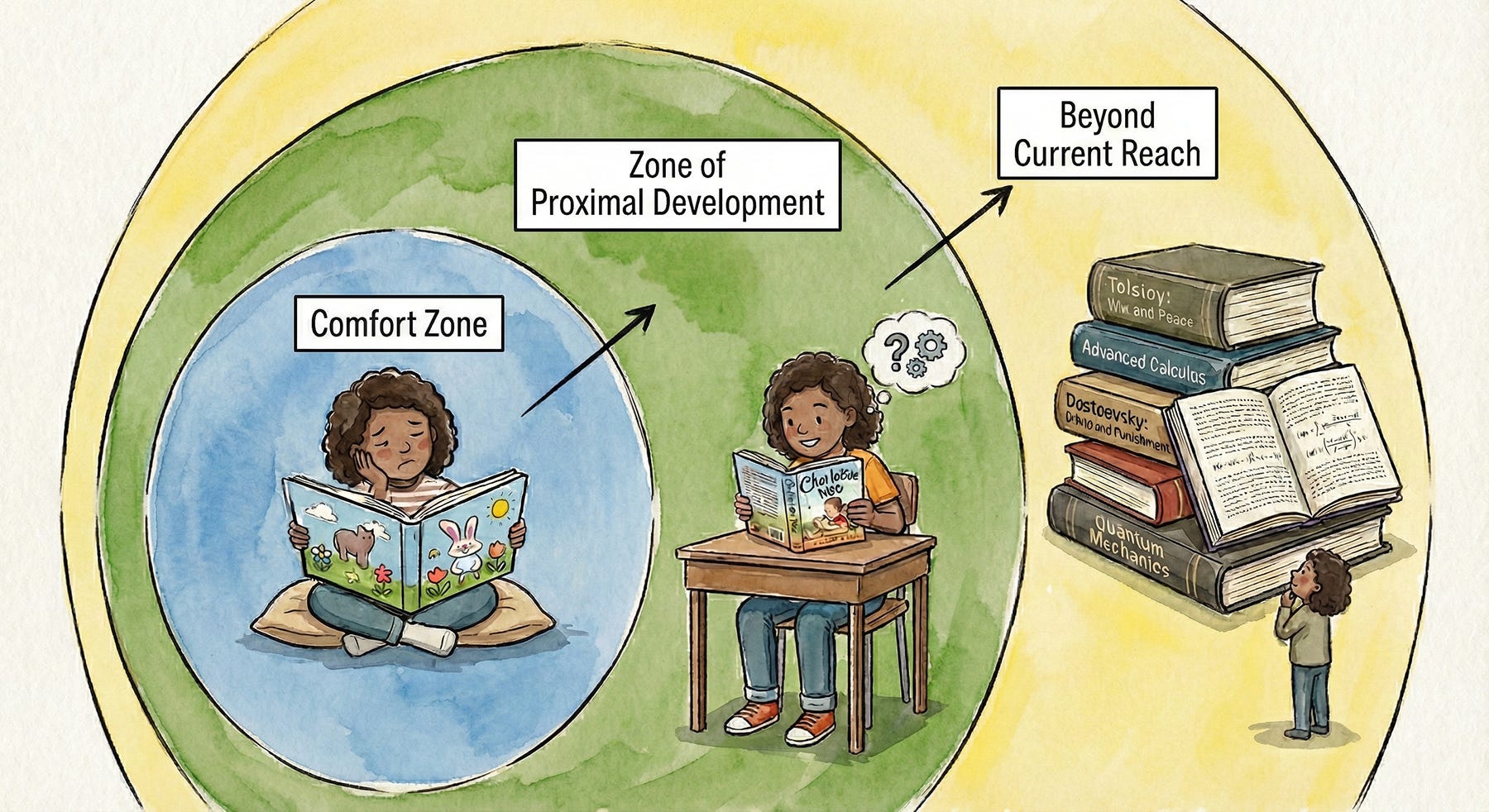
No child starts out reading Tolstoy. But if they stay with picture books forever, they won’t truly learn to read either. They have to move through the zone – always reaching for something slightly beyond their current grasp, then consolidating, then reaching again.
So you have to carry a weight that’s a struggle, but not so heavy that you can’t even pick it up. And you have to keep carrying it - and over time, your definition of what constitutes “hard” begins to change. That’s how you build the strength to face really hard things.
Now, most people get this wrong because they think the choice is between facing hard things or avoiding them. But that’s not really the choice. Hard things are coming either way.
In some cases, the hard things start out small, and then they grow.
The small hard thing is telling a client early that a project is going off-scope. The big hard thing is having to renegotiate the entire engagement three months in, when resentment has built on both sides and the relationship may not survive.
The small hard thing is raising your prices even when it’s uncomfortable. The big hard thing is a cash flow crisis that forces you to take any work at any rate, eroding your positioning (and your sanity).
When a team member’s work starts slipping, it’s hard to give them feedback. But it becomes a big hard thing six months later when you have to fire them – after the damage has spread, the client relationship has frayed, and you’ve lost sleep every night in between.
Those small hard things, faced early, stay small. Avoided, they grow. The cost of avoidance compounds, and the interest rate on avoidance is brutal.
But there’s another layer too. Not every big hard thing starts as a small one you could have handled earlier. Some challenges arrive fully formed – a market shift, a key employee leaving, a client emergency. You don’t get to choose whether (or when) those show up. You only get to choose whether you’ve been training for them.
Do the small hard things consistently, and you build the capacity for the big ones – whether they grew from neglect or arrived out of nowhere. And in light of your expanded capacity, those hard things (that would seem huge to someone else) are manageable – just another small hard thing.
But if you avoid the small hard things, then when the big ones arrive you won’t be equipped. You never carried the calf, and these hard things will land on you with a crushing force that you may not be able to withstand.
Jerry Rice, who is widely regarded as the greatest wide receiver in NFL history, put it simply:
“Today I will do what others won’t, so tomorrow I can do what others can’t.”
And Rice trained like that for twenty years. There was no point where he’d done enough and could coast. That’s the part most people miss about success, especially for entrepreneurs.
Trains vs. Surfboards
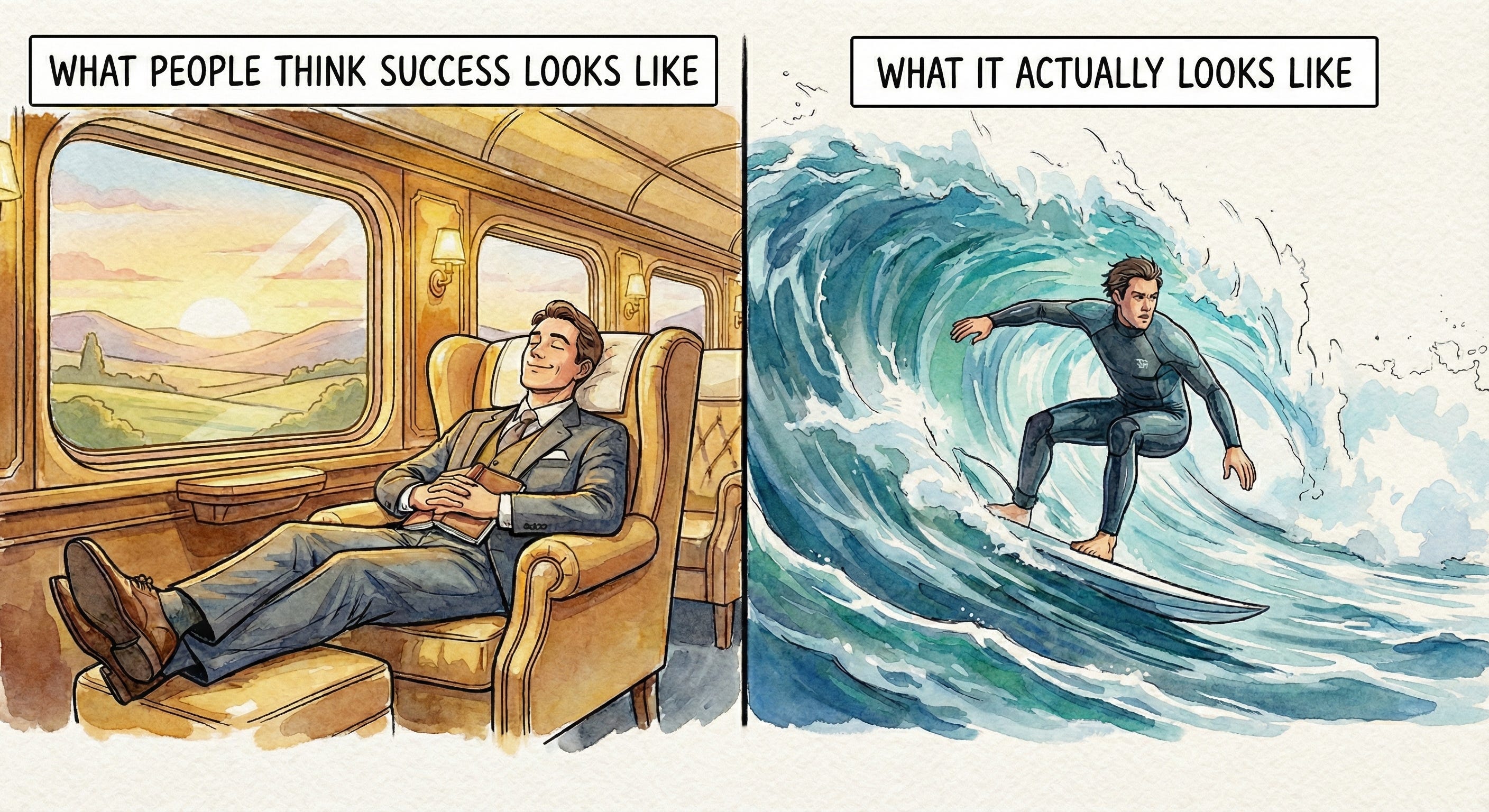
Most people conceptualize making it in business as being analogous to catching a train. You may need to hustle for the ticket, or make a mad dash to get on board. But once you’re on, you’re on. You can sit back and relax. Enjoy the view through the window as the train carries you forward.
This is the fantasy of building something so you can make money while you sleep. But entrepreneurship doesn’t work that way. It’s more like surfing than riding a train.
The water never stops moving. You don’t get to lie down and nap on the board. Your stability comes from your trained ability to respond to what’s always shifting beneath you.
Some traditional career paths do offer something closer to the train. You get seniority or tenure, or an institutional position. You earn status you can coast on. But fewer and fewer of these positions are available as the economy evolves. And changes from AI will make them ever more rare.
In any case, entrepreneurship is not a train ride – and neither is life. There’s no coasting, and there’s no arrival. You’re either moving forward, riding a wave, or you’re falling off the board and getting back on.
So the small hard thing isn’t optional here. It’s how you stay upright.
I don’t mean to suggest that this is necessarily easy. Entrepreneurs are not weak people. They’re ambitious, capable, often brilliant. And still – it’s human nature to avoid the small hard things.
We don’t want to send the outreach email. We don’t want to make the ask. We don’t want to have the conversation we’ve been postponing for months. We don’t want to post the piece that actually says something, instead of the safe take that gets ignored. We don’t want to fire the client who’s draining our energy and poisoning our calendar. We don’t want to admit to ourselves that the strategy isn’t working and something needs to change.
I get it. These things feel hard.
But I’ve come to believe the difficulty is mostly invented. It’s unfamiliarity in disguise. The first cold pitch feels impossible. The two-hundredth is unremarkable. The first time you tell a client no, your heart races. The fiftieth time, it’s just a sentence.
What feels like courage is often just exposure. The small hard thing is only hard until it isn’t.
The Lesson That Traveled Home
Somewhere in your work right now – probably somewhere you’ve been actively not looking – there’s a small hard thing waiting. You know what it is. A conversation or a decision. An email sitting in the draft folder. A commitment you’ve been circling for weeks.
The specifics don’t matter. What matters is that every day you walk past it, you choose the elevator. You decline to carry weight that would make you stronger.
There’s always a reason. There’s always a later. There’s always a more convenient time that never arrives.
Meanwhile, the capacity stays unbuilt. And the next big hard thing – which you and I both know is coming – will find you unprepared.
So take the stairs. Send the email. Have the conversation.
Carry the calf.
Always do the small hard thing.
That’s what I explained to Micah. Of course, when you tell your kids things, you never really know what lands. You say a lot of words. You hope some of them stick. Most of the time, you have no idea.
But a few weeks after we got back from Mexico, I overheard the kids at breakfast. Priya, who’s ten, was talking about something being difficult – I don’t remember the specifics. But Micah, unprompted, said: “Priya, you should always do the small hard thing.”
She asked what he meant.
So he began to explain, “Well, there was this guy named Milo, who had a baby ox...”
If you’re enjoying these essays on business, leverage, and growth, my new book AI Curious explores how AI changes the way we think and work.
Get your copy here →
Last week, while in the gym with my trainer, I mentioned to him how I want to start using the 1% rule (from “Atomic Habits” I think?) to increase my weight-lifting in 2026 gradually. Like the boy and the ox story.
What resonated with me from this Substack? The “wave” of Entrepreneurship - SO TRUE!
Great job for teaching kids important life lessons early, Danny! Growing up in an Indian household, the focus at home has always been exceling in Math and Science and nothing beyond that, so your post underscores the importance of lessons beyond academics. I shared the Ox story with my kids, and they got it, I think :)
I especially love your point about doing small hard things consistently to increase your capacity for the big hard things, such an important lesson.