
A World That Keeps Getting Bigger



One weekend earlier this year, two small frictions ran through our house – both involving my daughter Priya.
The first was a high school open house. My wife Bhoomi wanted her to go to at least one, just to look. Priya didn’t want to. She’d already picked her high school (a good one, that most of her friends are going to), and she didn’t see why she should spend a Saturday morning walking through other campuses she wasn’t going to attend.
The second disagreement was smaller. Priya had found a game she wanted on Amazon. Bhoomi suggested going to the toy store instead, to see what else was there. Priya wanted to buy the thing she already knew she wanted.
Neither was a fight. But I could tell both were about the same thing, and it wasn’t the school or the game.
So I took Priya for a walk.
I started by telling her I trust her judgment. Stick with the school, get the game from Amazon – it doesn’t matter. I was fine with it and wasn’t going to argue her into doing anything differently.
Then I listed a few of the things she loves. K-Pop Demon Hunters. The Keeper of the Lost Cities books she’d disappeared into for weeks at a time. Her friend Isabel. A handful of other things, that are real parts of who she is right now.
She nodded. She loved all of those.
So I said the thing I’d taken her on the walk to say. Five years ago, you didn’t know any of these existed. And how much smaller would your world be without them?
She has them now because she tried things. Most of them didn’t stick – but every so often, she’d try something that became one of the best parts of her life.
I didn’t care whether she went to the open house or the toy store. But I do want her to keep putting herself in situations where that could happen again – because that’s how our worlds keep getting bigger.
When Fear Looks Like Conviction
Priya’s version was easy to see – she’s ten, and the stakes were a high school open house and a trip to the toy store. But adults run the same calculation every day. We just have better names for it.
You’ve picked a direction. You’ve invested in it. You’ve told your team, your partner, and your customers what you’re doing. Then you’re on a call with someone whose thinking you respect, and they mention a book that comes at the problem from a different angle. They’re still mid-sentence when you know what you’re going to say. “I don’t have time for that right now.”
Sometimes it’s true. Other times, your calendar has nothing to do with it. You decided, before the new thing had a chance to land, that you’d rather not know.
It shows up in smaller moments, too. A colleague tells you about a tool she’s been using, and you nod along but you’ve already decided you’re not going to try it. A friend offers a take that doesn’t quite fit your worldview, and you change the subject. None of these are wrong on their own. Most of the time, you’d be entirely justified in passing on. But notice how fast you decided, and how little you actually let in before you did.
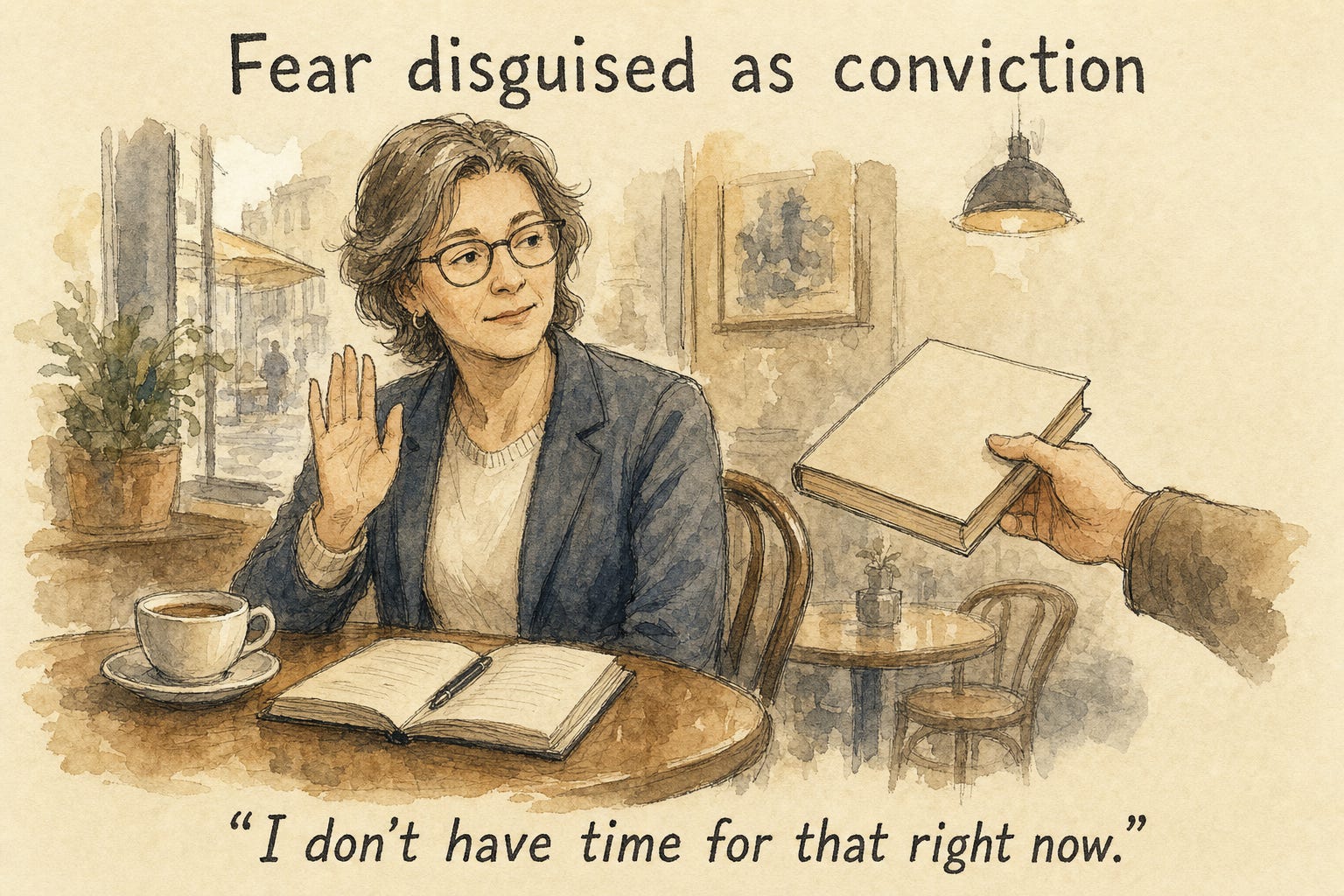
Maybe the detour really would have been a waste of time. But you didn’t actually find out. And what you really protected wasn’t your time. It was a position you’ve never had to defend.
When It Looks Like Curiosity
The other version of this seems like the opposite. It’s the person who can’t stop looking. And a lot of smart people fall into this. Maybe your business isn’t growing the way it should, or the thing you used to be sure of isn’t holding up. So you start searching.
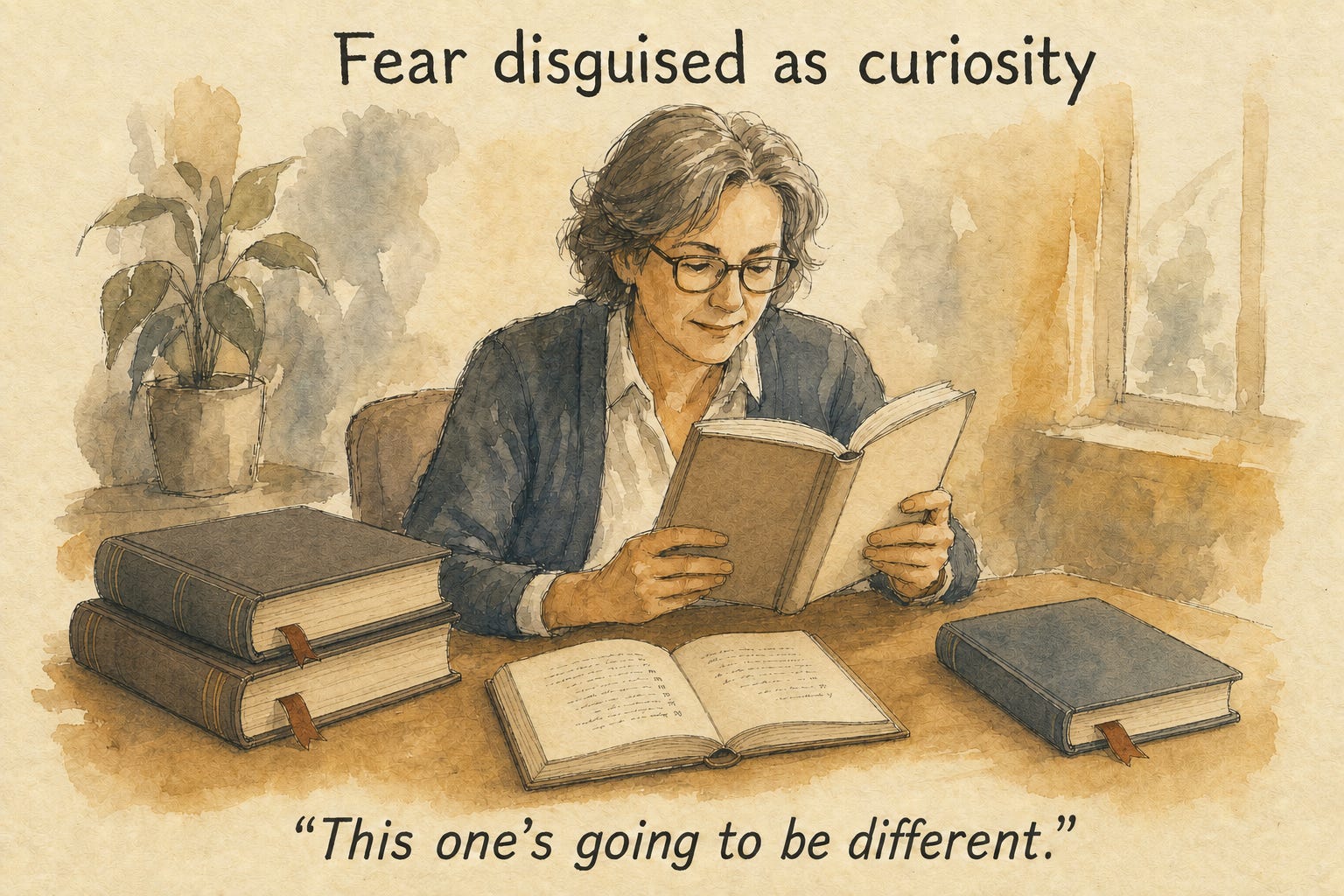
You read a book about positioning, take notes, and mention it to a friend on a walk. Two weeks later, the book is on the floor next to the bed, and you’ve started a new one – one a podcast guest mentioned, that everyone’s been talking about. This time you’re sure.
Six months in, you haven’t applied anything from either book. The course you bought in March is still waiting for the right week to put it into action. You can hold your own in a conversation about almost anything in your field. But nothing you do is different. You picked up new language. You didn’t pick up new practice.
It really does look like curiosity. And it almost is. But the engine underneath isn’t quite curiosity – it’s the suspicion that you don’t actually have an answer to your own question, and the hope that the next book is going to hand you one.
So you keep reading. The next one might be it. So far, none of them have been.
Branches from the Same Trunk
From outside, the two patterns don’t look anything alike. One person is decisive. The other can’t sit still.
But notice what each is doing with the new thing in front of them. The first decides, fast, that it doesn’t have anything to offer. The second decides, also fast, that the next thing is going to be the one. Neither of them stays with what they have long enough to test it.
What are they both avoiding? The struggle of deciding whether the position they’re operating from actually holds up when something pushes on it. The first skips the test by keeping anything new at arm’s length. The second skips it by never staying with a position long enough for anything to test.
Both are running on conviction they haven’t earned. And both are protecting against the same fear: that the world, given the chance, will take from them.
When the Ground Is Solid
What changes this is putting what you’ve got in contact with reality, and finding out it holds.
After that, the strong opposing argument from someone you respect is just material to think with. A book is just a book. A conversation with someone who sees the world differently is just a conversation – you stay curious about how they got there, and your thinking gets sharper for the company.
You’ve felt this. You’re on that same call, and someone pushes back on something you’ve thought about for a long time. But this time, you don’t flinch. You’re not running the math on how to respond – you’re actually listening, because you want to know if they’ve found something you missed. Maybe they have. If so, you want it. And if they haven’t, you’ll know that too, and what you’ve got will be a little more solid for the contact. That’s the difference. Same room, same conversation. But nothing in you is bracing.
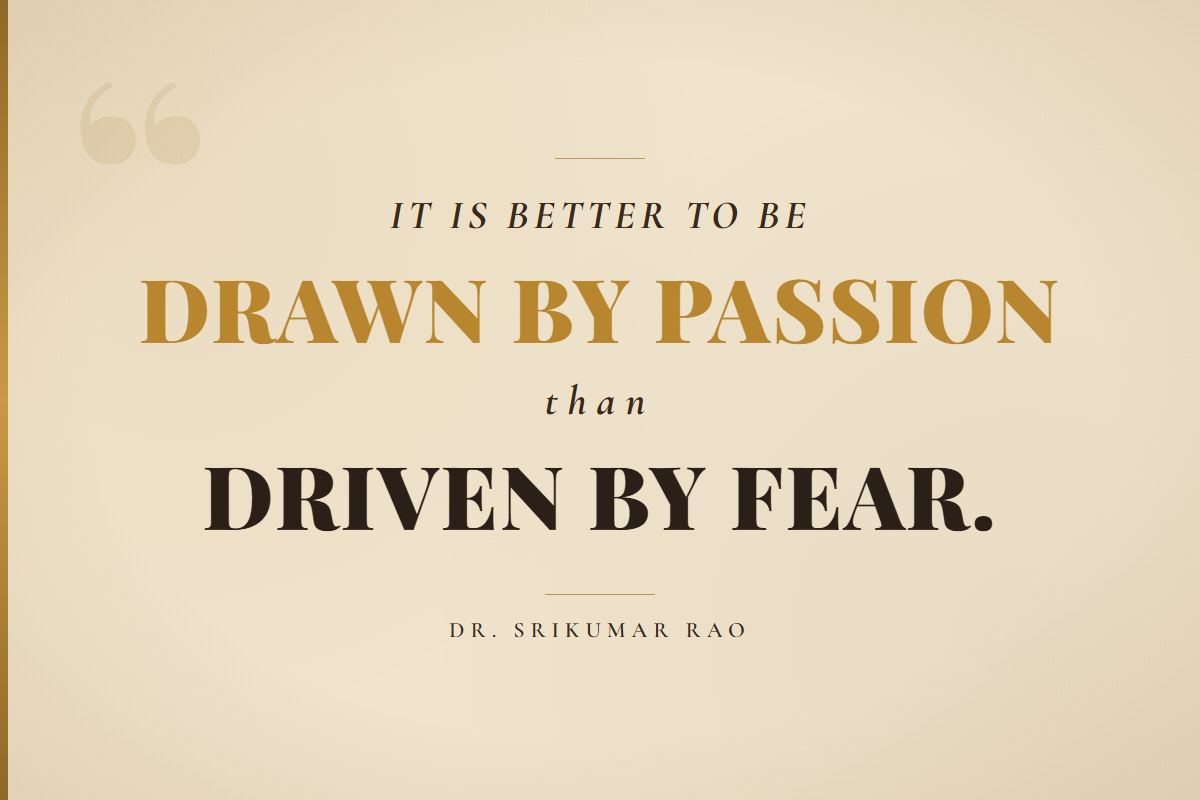
A mentor of mine, Dr. Srikumar Rao, used to say it is better to be drawn by passion than driven by fear. If you trust what you’re standing on, you’re drawn forward by what’s interesting – by what you didn’t yet know to ask about. When you don’t, the same motion is driven by something else – by the need to protect, or the need to keep searching for an answer you could have built yourself.
Once you trust what you’ve actually got, every open door stops looking like a threat. Most of the time, you come back with what you went out with. Sometimes you come back with one more thing you didn’t know you wanted. Either way, your world is a little bigger for the trip.
What I Actually Want for My Daughter
I didn’t tell Priya any of this on the walk. She’s a sharp kid, but at ten years old, a lecture about agency and friendly universes wouldn’t have landed.
What I told her was smaller. The life she has right now is full of things she didn’t know existed five years ago – K-Pop Demon Hunters, the Keeper of the Lost Cities books, her friend Isabel, a handful of other things that are real parts of who she is. Most of what she tried in those five years didn’t stick. A few of them turned into the best parts of her life. K-Pop Demon Hunters didn’t replace Keeper of the Lost Cities.
The new things got added to what she already had. She’s been doing this her whole life. She just hasn’t noticed that it’s never once cost her anything she already loved.
What I want for her, more than any particular decision about a school or a game, is that she keeps saying yes to the kind of moment that gave her any of these in the first place.
Her world will keep getting bigger. Not because she makes it bigger. Because she lets it.
If you’re enjoying these essays on business, leverage, and growth, my new book AI Curious explores how AI changes the way we think and work.
Get your copy here →
What I found interesting in this episode is that young people are doing the same thing that those of us who have lived 7 decades are doing, closing the door to a crack to avoid letting in new information. The reasons for wanting to keep the virtual door closed may differ; however, young and old tend to want to keep things familiar and easy, and to avoid strain on the brain. New ways of thinking and doing bring about anxiety, tension, and time and energy costs. Initially, it doesn't seem to matter that "new" can actually bring calm, ease, efficiency, and cost-effectiveness. But maybe you may even prefer the new to what is currently being used. If you keep your eyes closed and fingers in your ears, you will definitely miss a golden opportunity.
Thank you, Danny. Beautiful words and context for anyone at any age.